Anarchy is the true nature of all things. Monarchy, democracy, communism, all useless forms to control the human mind. But a mind cannot be control. It cannot be restrained. It has no boundaries. It has its will. Anarchy is the true nature of all things...
Goin on holiday, so there wont be alot of stuff happenin on my blog, till next year, happy happy to all and all that stuff, if you travel, travel safe please!!!!
Its been an exiting year, congrats to all of us for being named TIME'S person of the year!!
Personally its also been a roller coaster ride, but eagerly awaiting the next year.
I will leave you with this thought,
When they kick at your front door, How you gonna come?With your hands on your head, Or on the trigger of your gun!
Some say the end is near. Some say well see armageddon soon. I certainly hope we will. I sure could use a vacation from this
Bullshit three ring circus sideshow of Freaks
Here in this hopeless fucking hole we call la The only way to fix it is to flush it all away. Any fucking time. any fucking day. Learn to swim, Ill see you down in arizona bay.
Fret for your figure and Fret for your latte and Fret for your lawsuit and Fret for your hairpiece and Fret for your prozac and Fret for your pilot and Fret for your cable and Fret for your car. Its a Bullshit three ring circus sideshow of Freaks
Here in this hopeless fucking hole we call la The only way to fix it is to flush it all away. Any fucking time. any fucking day. Learn to swim, Ill see you down in arizona bay.
Some say a comet will fall from the sky. Followed by meteor showers and tidal waves. Followed by faultlines that cannot sit still. Followed by millions of dumbfounded dipshits.
Some say the end is near. Some say well see armageddon soon. I certainly hope we will cuz I sure could use a vacation from this
Silly shit, stupid shit...
One great big festering neon distraction, Ive a suggestion to keep you all occupied.
Learn to swim.
Moms gonna fix it all soon. Moms comin round to put it back the way it ought to be.
Learn to swim.
Fuck l ron hubbard and Fuck all his clones. Fuck all those gun-toting Hip gangster wannabes.
Learn to swim.
Fuck retro anything. Fuck your tattoos. Fuck all you junkies and Fuck your short memory.
Learn to swim.
Fuck smiley glad-hands With hidden agendas. Fuck these dysfunctional, Insecure actresses.
Learn to swim.
Cuz Im praying for rain And Im praying for tidal waves I wanna see the ground give way. I wanna watch it all go down. Mom please flush it all away. I wanna watch it go right in and down. I wanna watch it go right in. Watch you flush it all away.
Time to bring it down again. Dont just call me pessimist. Try and read between the lines. I cant imagine why you wouldnt Welcome any change, my friend.
We have a variety of logos commemorating holidays and events. We've put them in this online museum for your amusement. Please do not use them elsewhere.
And please, don't feed the kangaroo. If you would like to include a link to Google on your site, please use one of our official logo stickers.
Who's behind the oodles of doodles Google doodles for you? Find out...
People are asking: "Where are the comics?!" - Well, the invisible people in my brain that is! Anyway, here's a batch of comic books based on my favourite 80's animated-series-based-on-a-toyline (tied with Transformers). To say I have a soft spot for this franchise is an understatement: I love Masters of the Universe!! From 1983, we have the mini-series from DC Comics plus DC Comics Presents #47 in which He-Man teams up with Superman! Then we have Marvel's mid-80's effort under the Star Comics banner (a comic book line aimed at younger readers) plus the movie adaption, and the more recent Image and Crossgen series based on the excellent but short-lived 2002 toyline and animated series reboot. Enjoy!Complete DC Comics Mini-Series plus DC Comics Presents #47 15.7mbComplete Marvel Star Comics series plus Movie Adaption 67.1mbImage Series 1 36.6mbImage Series 2 46.1mbEncyclopediaRise of the Snakemen 31.3mb #1-3Icons of Evil 58.9mb
Popcorn is a 1996 novel and play by the British writer Ben Elton.
Plot introduction
The book takes place in different parts of Los Angeles, US. The date is never actually specified, but various clues suggest it is set in the near future. Mostly the story takes place in the center of Hollywood. By showing different environments the reader can see the big differences between different social groups in America. From the rich people with guards, Bruce Delamitri for instance, to the less rich people like Wayne and Scout. But apart from that it doesn’t matter where it takes place, it could be in almost any other country with the same differences between classes. But since one of the most important things with this book is that the country has a huge movie industry where much circles around violence the country where the plot eventually could take place has to be a country like that.
The protagonist, Bruce Delamitiri, is an artist who works in the motion picture industry. Many people in the US think that, by making these movies, Bruce makes killing cool. They think that he encourages everyone who’s watching these movies to kill for fun. Bruce, on the other hand, defends himself by telling everyone that he doesn’t think that he encourages anyone to do anything. He says that there has always been violence but humans are not like robots, seeing something on the screen does not necessarily make us want to do it ourselves(p.13 “people get up from the movie theatre or the TV and do what they just saw”). He also claims that he is just showing existing violence. Unfortunately for Bruce there are two people, Wayne and Scout, who kill for fun. They are called the Mall Murderers because they kill in the way the characters kill in Bruce’s movies.
The novel begins with Scout and Bruce in their respective interrogation rooms, being questioned on the night before, the night Bruce won an Oscar. After the ceremony and after-party Bruce and a nude model (who asks that she be called an actress) named Brooke Daniels leave to Bruce's Hollywood mansion. She tricks and threatens him into promising her a place in his next movie. They then begin foreplay but the climax of the novel starts when Wayne and Scout visit Bruce’s house. They want him to tell the whole US that he is responsible for what they have done. In other words he has to tell everyone that he lied before, when he said that he wasn’t responsible for the violence in the US. In the end many people die, Wayne and Scout don't get what they wanted, Bruce loses many people he knew, for example his ex-wife and his daughter and no one wants to take the responsibility for these peoples' death.
Characters in "Popcorn"
Bruce Delamitri – main protagonist, an artist
Wayne – A killler
Scout – A killer
Brooke Daniels – A Model / Actress
Velvet Delamitri – Daughter of Bruce
Farrah Delamitri – Soon to be divorced wife of Bruce
Karl Brezner – Bruce's producer
Bruce Delamitri is certainly not a hero, he is just an ordinary American except that he has got an Oscar for Best Director. He is about 30 years old and he has an ex-wife and a daughter. He is quite conceited, he wants everyone to love him and adore him. But on the other hand
"Bruce do not consider himself conceited about his work. He was the first to admit it was popcorn, but only if the other popular and corny works like Romeo and Juliet and Beethoven’s Fifth were popcorn too." (p.)
He wants to be laid-back street cool. If someone dares questioning his movies that person is a dork. In other words he is keen on showing his disdain for that person. He believes that everyone plays the victim, just to blame their faults on something or someone. Everyone looks for an excuse to fail. All these things make it hard to sympathise with him. He is really not a person I would like to get to know. It is hard to sympathize with anyone in this novel. The narration has made it impossible to sympathise with any one of the main characters. It is only the people in the background, the people you don’t get to know who you sympathize with, particularly all those who are murdered by Wayne and Scout.
Literary significance & criticism
Mood of the novel
It can be perceived that the author, Ben Elton, wanted to create a world full of irony (which is one of the foundations of movies, of which this novel is highly influenced, including dramatic and important sequences in screenplay format at times). The story is a satire of the society. We live in a society where no one wants to take the responsibility. A human can make mistakes, but he can always claim that it is because of something, perhaps he or she had a very miserable childhood. Perhaps it is someone else’s fault. All these contents create a witty and neutral mood. The story is full of witticism and when someone gets killed you feel nothing, no compassion, no anger, nothing.
Structure of the narrative
The narrator, Ben Elton, was born in 1959 in London. He could have been inspired to write this book with all the movies during the 1990s(the book is written in 1996), like for example Pulp Fiction. Pulp fiction contains a lot of violence, which the protagonists', in Popcorn, movies do too.
The book is told from an omniscient point of view. This makes it possible for you to catch many situations and the main characters' emotions. The story is created in retro perspective. It starts to show Bruce the day after it all happened. After that there are glimpses from everywhere in like 24 hours until the day after. The sentences are structurally straightforward but the vocabulary quite extensive. It is written in a mix of irony and wit. But it is probable the narrator wanted his work to be ironic.
Major themes
Popcorn deals with the theme of taking responsibility for one’s own actions, and how this has been lost in a modern society in which everyone sues everyone else.
The word "responsibility" is used frequently throughout the novel, in both narrative text and in dialogue.
Ethics, moral responsibility, society; film violence
Summary
Bruce Delamitri is a film director who makes very violent but stylish movies. ‘Bruce's movies are hip. Post-modern cinematic milestones, dripping with ironic juxtaposition. His killers are style icons. They walk cool, they talk cool. Getting shot by one of them would be a fashion statement’ (from the book cover).
Wayne and Scout are psychopaths who are killing people without apparent reason. Many people consider Bruce’s films to be the cause of the violence. As a way of avoiding the death penalty they decide that Bruce must take responsibility. They break into his house on Oscars Night and a terrible siege begins.
After the final bloodbath the arguments continue over who is responsible for a violent society—and this violence in particular.
WARNING: Contains strong language; violence; sex
Cultural significance
Popcorn stayed at the top of the hardback best-seller lists for quite some time before being released in paperback and has been translated and published widely around the world. It is also a successful West End play now at the Apollo Theatre, Shaftesbury Avenue, London W1 (directed by Laurence Boswell). Popcorn is also available as an audiobook read by John Sessions.
Mary Whitehouse praised Popcorn for its attack on sex and violence in the movies but Ben Elton has said "I don't think balanced people can be driven to be any different from what they are ... The suggestion is that those who are open to anti-social behaviour may be seduced into believing it is the norm ... I feel slightly exposed here because I am putting a point I don't entirely believe." (The Daily Telegraph, July 29th 1996).
Joel Schumacher (Flatliners, Falling Down, Batman Forever) has announced plans to direct the film version, and will apparently star Jeff Goldblum, Nathan Lane and Ellen Barkin.
Biographical background
Ben Elton was born in South London and studied Drama at Manchester University. His numerous television writing credits include The Thin Blue Line, Blackadder, The Young Ones and The Man from Auntie. He has written two hit West End plays and three previous internationally bestselling novels. His plays and novels have been widely translated. He tours occasionally as a stand-up comedian. Popcorn is his fourth novel. He is going grey, is married to Sophie Gare and lives in Notting Hill.
Other books by Ben Elton
Ben Elton, Batchelor Boys - The Young Ones Book spin off of the TV series which Elton co-wrote with Rik Mayall and Lise Meyer
Ben Elton Stark (1989) His first novel which sold massively in Britain and Australia. It was reprinted 23 times in its first year of publication, and sold over a million worldwide.
Ben Elton, Gasping (1990) Based on his successful West End play starring Hugh Laurie
Ben Elton, Gridlock (Warner Books 1991)
Ben Elton, Silly Cow (1993)
Ben Elton, This Other Eden (Simon and Schuster 1993)
The book opens with the narrative switching between Bruce Delamitri being interviewed by the police and him being interviewed by Oliver and Dale on Coffee Time USA the morning before. Most of the book is the events that took place in the intervening 24 hours.
On Coffee Time USA he is quizzed over a series of killings that had taken place, apparently copying killings depicted in his latest film Ordinary Americans. He is expected to receive the Oscar for Best Director that night but a controversy is raging over whether or not his films have given rise to this violence or whether they merely show life as it is. Bruce maintains that it is the latter.
The narrative then moves to switching between Bruce’s appearance on Coffee Time USA and the movements of Wayne and his pretty waif-like girlfriend Scout. They are known as the Mall Murderers and have been killing people across America in exactly the same way as the couple in Ordinary Americans.
Bruce protests in strong terms that the association between his films and these killings is an invention of news editors; he maintains that people aren’t influenced in such a direct way by what they see. He insists that ‘artists don’t create society, they reflect it. And if you don’t like that, don’t change us, change society’ (p. 14). Wayne and Scout are watching this in their motel room hatching a plan.
Bruce spends the afternoon before the Oscars addressing the film studies course at the University of Southern California where he himself studied. He impresses the students but not the dusty old Prof. Chambers who asks some very penetrating, critical questions and gets the better of a very angry Bruce.
Bruce arrives at the Oscars in a limo which crawls through the heavy traffic. He watches the crowds staring and straining to see who’s inside. ‘They couldn’t see anything: all the limos had mirrored windows, so all they could see was themselves… That was it! The whole truth in one startling image. Why were Bruce’s movies so successful? Because people saw themselves reflected in them. Maybe better-looking and a little cooler but none the less themselves, with their fears, their lusts, their most secret desires and fantasies… He was a mirror. He did not create a world for people to watch; they created a world for him to film’ (p. 54).
His acceptance speech at the Oscars is embarrassing waffle. At the same time, Wayne and Scout are moving on having murdered two people at the motel.
At the post-Oscars party Bruce drinking hard. He is rude to everybody—especially to a young woman named Dove who he accuses of making up ‘the terrible emotional abuse’ she’d suffered. Bruce claims to have an addictive personality and therefore was not responsible for his drinking. He rants about the victim culture and the lack of responsibility. Then he sees a Playboy model/aspiring actress who he takes home intending to sleep with her.
What they do not realise until they start to undress is that Wayne and Scout are in the house. Some hours later Bruce’s almost ex-wife, Farrah and their daughter Velvet arrive. Wayne phones the TV networks and soon a convoy of media vehicles and police arrive at the house and a siege commences. The Police Chief and the NBC chief vie with each other as to who is in overall charge of the situation.
Waynes’ plan is for Bruce to go live on every TV network to say that he is responsible for the Mall Murderers’ killing spree because his films had such a profound impact on them. That way Wayne and Scout, though guilty, are not ultimately responsible and will avoid the electric chair. If he won’t do it then he will kill Farrah and Velvet Delamitri and Bruce himself. Eventually Bruce and Wayne agree to debate it together on TV. Wayne has asked for a two-person news crew to come to the house—without clothes—in order to film this as well as a ratings computer so that he can see how many people are watching.
As the debate goes on, the ratings gradually drop until Wayne announces that he will kill Farrah in one and a half minutes. At the end of the time he does shoot her and the Police SWAT team start to enter the house. As soon as Wayne learns of this he says that he and Scout will give themselves up with no further bloodshed on the condition that everyone watching turns off their TVs. If they keep watching he will kill everyone in the room.
The SWAT team move in and there is a bloodbath. Bruce survived but his career didn’t; Scout also survived. Brooke, Velvet and the news crew as well as Wayne were killed. The epilogue of the book is a catalogue of litigation: everyone is blaming everyone else and suing them for damages over what happened. The book concludes, ‘So far no one has claimed responsibility.’ (p. 298).
Ideas for discussion
1) With which of the characters in the book does Ben Elton seem to have the most sympathy?
2) What do the various characters believe about human moral responsibility? What basis do they have (or are likely to have) for these beliefs?
3) What elements of truth and error are there in Bruce Delamitri’s argument that he is only holding a mirror up to society, not creating it?
4) What purpose do you think the confrontation between Prof Chambers and Bruce Delamitri serves in the narrative?
5) Which side of the debate over violence in the movies do you think Ben Elton is on at the end of the day?
6) To what extent has Elton glorified violence in his book in exactly the way the book seems to condemn in films? Is his use of violence legitimate because of the point that is being made?
7) Why do people want to see violent films? Does the public get what it deserves?
8) The controversy about film violence resurfaces fairly often. How could you bring a Christian angle to a conversation with a non-Christian friend when it is next in the news?
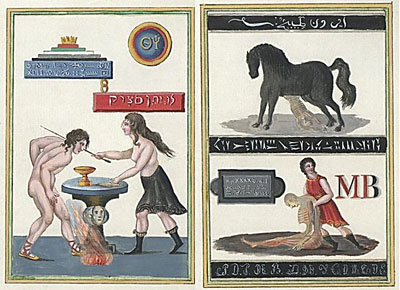
Bibliodyssey, a site devoted to rare old books and materia obscura, is one of my favorite blogs. Each page-load is like a peek into the most treasured recesses of an eccentric book-hoarder's stash. I have a tiny attention span and an aversion to collecting too many objects, so for me it's a dream come true. Here's a snip from today's entry, "La Très Sainte Trinosophie," which includes some pages of cool old magic code I don't understand:
The 'Cosmic Master of the Age of Aquarius' and mysterious adept, the Count de Saint-Germain, allegedly died in 1784. He was a spy, virtuoso violinist, diplomat, friend at the Court of Louis XV, adventurer and was said to be able to transform iron into gold. A veritable procession of people have claimed to be the still living Count de Saint-Germain since 1784.
"During the centuries after his death, numerous myths, legends and speculations have surfaced. He has been attributed with occult practices like snake charming and ventriloquism. There are stories about an affair between him and Madame de Pompadour. Other legends report that he was immortal, the Wandering Jew, an alchemist with the elixir of life, a Rosicrucian or an ousted king, a bastard of Queen Maria Anna of Spain, that he prophesied the French Revolution. Casanova called him the violinist Catlini. Count Cagliostro was rumored to be his pupil."
Either the Count de Saint-Germain or Cagliostro is considered to be the author of 'La Très Sainte Trinosophie' (The Most Holy Three-fold Wisdom), from the latter half of the 18th century. It has been called "the rarest of occult manuscripts"1 and the only surviving copy is owned by the library in Troyes, France.
Link to full text of blog post, with lots of big juicy page scans of the illustrations inside this book.
He who is not everyday conquering some fear has not learned the secret of life, said Ralph Waldon Emerson whose words ring truer than ever today. Overcoming fear is a set requirement of modern life while we’re fed a daily dose of terror by the state and media. Should we dread hoodies on the corner and Bin Laden or are our inner demons the fear we need to conquer? What are you afraid of and why? How can you overcome your fear...?
If you use Wordpress and your blog looks good, you probably have Theron Parlin to thank. One of the most downloaded designers of Wordpress themes, Theron is currently at Start Us Up, a start up based in Framingham, MA that writes and releases cool web applications and helps other companies bring enterprise level success to their ideas while building lots of relationships.
Theron recently gave away his Technorati Top 10 blog, Thought Mechanics, and started a new, more modest blog called ZeroRule, where he talks about web development, technology and things generally related to Theron.
It is our pleasure to present his top ten best designed web sites of 2006... with his comments... after the jump
http://www.drivl.com/ Drivl is a cool blog with dark colors and nice fonts. The overall layout is pretty straight forward, but there's a lot of subtly going on. I first found this site when I was searching for something related to digg and found this article which sums up exactly how I feel about digg ( http://www.drivl.com/posts/view/465).
http://www.exozet.com/ Exozet Games is a game development studio from Germany. I picked this site for the great colors, great imagery and I like the side navigation tabs.
http://veerle.duoh.com/ Veerle's blog is probably one of the best blog designs I've ever come across. It's a little busy for my personal taste, but it was flawlessly built with obvious attention given to every last detail.
http://www.enigmind.com/welcome.php I personally don't care for flash sites. I did at one point, but now I just think most of them are way over done. That said, enigmind is a best of breed flash website with a killer design, and fluid animation.
http://www.artypapers.com/ap.log/ Artypapers is the site and blog of R. Marie Cox, a Web Developer & Designer. The site is simple with a bright look and feel. You can't help but smile while looking at it.
http://www.emilychang.com/ Emily Chang is a designer from San Francisco. I picked Emily's site because I love the simplicity, colors and whitespace. I also like the flash image thingy at the top of the page.
http://crowdctrl.com/ At CrowdCtrl, the word is definitely grunge. If you're a fan of grungy and distressed looking sites, this one is for you. Great use of graphics and fonts.
http://www.thebeststuffintheworld.com/ "The Best Stuff in the World is an open, organic, polymorphous site which, depending on the user, could take on diverse forms and meanings." I chose this site because I love the layout and colors.
http://www.kcrevolution.org/ I'm not someone that people would point to and say, "now there's a religious fella." However, Revolution Church, Kansas City pulled out a top notch design that I think is more than worthy of making the list.
http://hicksdesign.co.uk/journal/ Hicks Design is the perfect blend of simplicity, whitespace, intricacy, color, fonts and elements. Jon Hicks continues, with each iteration of his site, to be one of the best designers on the planet
Legendary NYC art writer Carlo McCormick on the eve of 11 Spring’s public opening
For months now “The Candle Building” aka: 11 Spring Street, has been undergoing extensive ornamentation by NYC street and graffiti artists under close supervision by TheWooster Collective in preparation for this Friday’s three day public opening, after which the historic space will be transformed into upscale condos. A longtime destination for the city’s graff community, this formerly abandoned space has been a virtual museum of spray paint and wheatpaste installations for years now. Luckily, the building’s new owners had the foresight to recognize the space’s artistic role in the community and turned it over to the WC to curate a last gasp show of the town’s biggest & brightest who have left no spot uncovered in their last grab at fame on the building’s walls. Don’t miss your chance to see one of the city’s most exciting (and free) art exhibits in years: Friday, December 15th: From 11am to 5pm; Saturday, December 16th: From 11am to 5pm; Sunday, December 17th: From 11am to 5pm (special artist panel discussion at 3pm)…
Click HERE to read the NY Times article on the project.
John Esther actually hates roundtable interviews. And understandably so, of course. But we asked him not to pass on this one: David Lynch and Laura Dern, talking about their latest collaboration, Inland Empire. And towards the end: a few words in remembrance of Robert Altman.
Related: "[A]fter two viewings, I cannot wait to see it again." Scott Foundas in the LA Weekly: "[T]he thrill of Inland Empire lies, I think, in surrendering yourself to its epic weirdness, falling under its spell and allowing Lynch to gradually lead you back into the light."
We all wish their work was obsolete... The Surveillance Camera Players (famous for manifesting their opposition to the culture of surveillance by performing silent, specially adapted plays directly in front of surveillance cameras) have just published a book that documents their performances and comments on the right to privacy, the militarization of the police, the ideology of transparency, the mass psychology of fascism, the society of the spectacle, the PATRIOT Act, Rudy Giuliani, September 11th, face recognition software, reality TV, webcams and wireless systems, among other topics.
Wireless Internet cafes are the most cost-effective office space ever, but you know you're mooching. A cup of coffee is good for thirty minutes at a table, but what if you're going to be there all day, maybe every day? After the jump, the unpublished rental rates.
"Here at Coffee To The People, we need to bring in on average $100 PER HOUR simply to cover our costs," CTTP staffer Karin Tamerius blogs from her Haight-Ashbury establishment. "That means, if all of our customers were people who stayed for three hours and spent $1.50 for coffee, we would require 200 people in our shop every hour we were open, 7 days a week, just to stay in business."
The solution? For the progressives at CTTP, it's obviously a sliding scale: Karin suggests $3/hr in food and drink purchases for students, $5 for SVUG-reading professionals. The basic P&L is the same for most Bay Area cafes. Caffe Roma in North Beach posts its value proposition: "If you are extending your stay, please purchase another item." But there are several more undocumented parameters:
Unless the place has a sign forbidding laptop use, you're welcome to boot up.
If you're not paying for Wi-Fi, spend about $5 an hour on coffee, snacks and tips. If the place is packed, make it ten.
Not hungry? Take your five-spot and put it in the tip jar.
Carry a power strip! One outlet can power twenty 100-watt laptops without blowing a fuse. That's still less wattage than your hair dryer.
Hogging the socket is the #1 laptop offense. If there aren't enough power outlets for everyone, charge up your laptop just enough to run for an hour. Then let someone else jack in until you need to recharge.
Laptop Offense #2: If it's crowded, offer to share your table.
NICK DOUGLAS -- Good deals are obvious. Great deals are not. News Corp's $580-million purchase of MySpace was "Murdoch's Folly" no more when Google paid $900 million to power MySpace search. In that spirit, here are the top nine business moves from 2006 that don't make sense -- at first. Below, the video that started Deal #1.

Amanda and Andrew go ballistic: "I apparently have been unboomed," said Amanda Congdon, host of Rocketboom, outing a behind-the-scenes feud with her producer Andrew Baron (video below). Critics (including me) thought the whole ordeal, with both Amanda and Drew slinging accusations and legal threats over the show's ownership, made these Internet stars a laughingstock. But at least it bought them some publicity while Baron found a more experienced host (who quickly won converts) and Amanda chatted with media companies and landed at ABC.
Google buys YouTube: 1. Start site for cool legit reason. 2. Let a bunch of people use it to post Family Guy clips. 3. Pants dangerously close to being sued off. 4. Hop on Google's white horse, cut deals with those who almost sued you, hint at paying users in the future. Profit!
Dave Winer quits blogging: Enemies cheered the promise that technologist and RSS innovator Dave Winer would stop blogging at Scripting News. But so did friends, who knew that if Winer stepped back from his constant updates and the fights they sometimes bring, he'd finally be able to return to the important work of -- sorry, wait, he's staying until April. Turns out he does this all the time. And maybe that's clever, since it always fools those of us who haven't spent the last ten years reading this Armchair Everything.
Mike Arrington throws a party: The TechCrunch founder threw parties before, but this year they finally broke the capacity of his ranch house. Arrington says he pulled in over $50k from TechCrunch 7, a long schmooze held at the offices of investment firm August Capital. Good thing his parties are so profitable, because that blogging thing ain't working out.
Jason Calacanis ruins Netscape: AOL put the cocky Weblogs, Inc. founder in charge of its dying Netscape.com portal. No one's been able to keep the site's traffic from falling. Neither has Calacanis, say outside reports (which he and employee C.K. Sample dispute), but that's not what matters. Calacanis turned Netscape into a clone of social news site Digg and paid top users with AOL's money, thus turning a failure into a high-profile failure (did anyone know Netscape.com was even still up?). The gig kept Jason on the radar long enough to let him prepare his next project -- outside AOL.
Craigslist stays poor: "Poor" here means "raking in millions." Craigslist's founder and CEO have said (again and again and again and again) that they're not selling the company or milking the site for ad dollars. Instead they'll pull in mere tens of millions for their 22-person operation. After all, the billionaire life is for the fake humble, not the truly humble.
Yahoo keeps Terry Semel: The CEO looked so close to retirement that when Valleywag heard the company was announcing something big, our publisher posted an obit for Semel's career. Too soon, it turns out, as Semel is still in charge of the newly reorganized Yahoo. Or at least he'll stick around until the changes are made. It's a lot smarter than putting a new CEO (read: CFO Susan Decker) in charge while the company's still on shaky footing; by the time Decker rises to the top, the exec team (including Decker, who will oversee one of the company's three divisions) will have sorted things out.
Apple doesn't reinvent the iPod: Every time Steve Jobs stands in front of more than five people at a time, he's expected to finally introduce the iPhone or the full-screen iPod. The time may come for those products, but this year the iPod only gained a few gigs, went micro on the low end, and dropped the glassy look -- nothing that renders a pod from January obsolete. Why wait? To give Microsoft's Zune some time to wallow before crushing sales with a new player early next year.
Essentiall this app backs up the hidden file that makes your computer “authrized” and de-authorizes it. Then it reloads the backed up files thus re-authorizing the computer but without iTunes knowledge. Then go out and do it to all the computers you want.
Ego depletion refers to the idea that mental activity that requires self-control (i.e., the ego) relies on an energy that can be used up. When that energy is low, mental activity that requires self-control is impaired. In other words, using one's self-control impairs the ability to control himself or herself later on. In this sense, the idea of willpower is correct. In an illustrative experiment on ego depletion, participants who controlled themselves by trying not to laugh while watching a comedian did worse on a later task that required self-control compared to participants who did not have to control themselves while watching the video, such that they did not try to control their laughter but rather watched the comedian without trying to control their laughter. References: Baumeister, R. F., Bratslavsky, E., Muraven, M. & Tice, D. M. (1998). Ego Depletion: Is the Active Self a Limited Resource? Journal of Personality and Social Psychology, 74(5), 1252-1265; Muraven, M., & Baumeister, R. F. (2000). Self-regulation and depletion of limited resources: Does self-control resemble a muscle? Psychological Bulletin, 126, 247-259; Muraven, M., Tice, D. M., & Baumeister, R. F. (1998). Self-control as a limited resource: Regulatory depletion patterns. Journal of Personality and Social Psychology, 74, 774-789.
I really, really was about to feel obliged to do one of those.
And NOW I can skip mine, and lazily sit back and judge theirs. Complete with its intelligent classifications and embeddedness and elegant organization.
So here’s what I think of their choices. Go to lulu.tv to check them out!
1. If you like machinima–you know who you are–this is as good as it gets.
2. “Desperate Mousewives.” Too low concept. I like a mash-up that makes a point.
3. “Return of the Rednecks.” Too cinematic, too well thought out, too long.
4. “Monster Rap.” Does NOT “blow ‘Lazy Sunday’ away.”
5. “Imagine This.”WOW. GREAT. But what does it point to? Bush’s secret message of peace? The banality of Lennon’s lyrics?
6. “The Last Night Mash.” Too many wacky male vloggers with the exact politics of Stephen Colbert.
7. “Fanny.” Love Fanny. Love her busted couch.
8. “Art of the Drink.” Earnest mixology makes a good vlog! When he pours, he reigns. etc.
9. “Star Trek: Infinitive Split!” What do you know. Star Trek gags can still be slightly, slightly funny.
10. “God Bless Americo.” I didn’t laugh, but I could imagine laughing, and the lechy guy is kind of sickly cute.
11. “Anniversary.” My second favorite, after the Bush “Imagine” thing. It’s just dumb and funny. Oh, and allegedly nsfw, but you can probably get away with it unless you work at NARAL.
12. THIS thing is like nothing else. Watch it. On a list by itself.
And at number 13. Lulu’s best overall is a big exploding gross-out gag for the 10-year-olds in the room. Kind of gives new meaning to the word “overall.”
But just watch lulu.tv and decide for yourself! Happy best-of lists!
Our friends @ Evil Mad Scientist has two open source holiday kits AND the instructions are in PDF AND made wit ComicLife, nice work!
"We have written instructions for building two sweet microcontroller-based electronics projects for the holidays: an alphanumeric LED christmas tree ornament and an LED mini-menorah (hanukkiah).
These are open-source projects; You can download and modify the source code, use it to program your own microcontroller, and solder the microcontroller to some LEDs to help make your own holiday decorations.
If programming microcontrollers is not your idea of a good time, we understand. Not everyone has (1) access to a microcontroller programmer, (2) the time and (3) the desire to modify the firmware of their christmas tree ornaments.
In order to help our fellow citizens Evil Mad Scientists with their holiday projects, we've put together electronic soldering kits for these projects which we are selling at cost. Each $5 kit includes the parts and instructions to build either an LED christmas tree ornament or an LED mini-menorah" - Link.
High speed flash photography kit
Mnorri just posted up a ton of great photos in the MAKE: Strobe Photography pool!
With the kit you can take "impossible" pictures, leaving everyone wondering "How did you do that?" Capture high-speed events -- A splash. Popping balloons. Breaking glass. Use your imagination! Adjustable flash controller triggered by light or sound. Kit includes a high-speed flash, disposable camera, flash controller and fully assembled flash trigger that synchronizes the high-speed event and the flash. The kit, more details, the photo pool and order one!
Shakedown 1979. Cool kids never have the time. On a live wire right up off the street, you and i should meet. Junebug skipping like a stone, with the headlights pointed at the dawn, we were sure we’d never see an end to it all.
And i don’t even care to shake these zipper blues. And we don’t know just where our bones will rest… to dust i guess, forgotten and absorbed into the earth below.
Double cross the vacant and the bored. They’re not sure just what we have in store. Morphine city slippin’ dues down to see that we don’t even care, as restless as we are. We feel the pull in the land of a thousand guilts and poured cement lamented and assured to the lights and towns below… Faster than the speed of sound. Faster than we thought we’d go. Beneath the sound of hope.
Justine never knew the rules, hung down with the freaks and the ghouls. No apologies ever need be made. I know you better than you fake it
to see that we don’t even care to shake these zipper blues. And we don’t know just where our bones will rest. To dust i guess, forgotten and absorbed into the earth below.
The street heats the urgency of now. As you can see there’s no one around.
Incredible Roy Doty Christmas card I must have been six or seven years old when I first came across Roy Doty's illustrations in a pile of old Popular Science magazines from the 1960s. Doty's "Wordless Workshop" comics featured a pipe-smoking dad who solved common household problems with ingenious but easy-to-make devices.
I instantly became a fan of his elegant, light-hearted, clear-as-a-bell drawings, and whenever I found old copy of PopSci at a garage sale or used book store, I'd tear through it until I found his two-page cartoon, which he started doing in the early 1950s.
A couple of years ago, I learned that Roy was still actively drawing, for magazines and books. I immediately emailed him and asked him to become the illustrator for MAKE magazine's puzzle page, called Aha! (in homage to another hero of mine, Martin Gardner, who wrote two books I treasure: Aha! Insight and Aha! Gotcha, now available in one volume). Roy was happy to oblige, and has illustrated the column ever since. I can't tell you how exciting it is to get the faxes with his rough sketches for the column. Of course, he needs no art direction; he knows exactly how to illustrate the puzzles.
Every year, Roy sends out whimsical Christmas cards, and this year's is a masterpiece -- a Mousetrap / Rube Goldberg-style holiday celebration machine. Link
A highly superior being from another part of the galaxy presents you with two boxes, one open and one closed. In the open box there is a thousand-dollar bill. In the closed box there is either one million dollars or there is nothing. You are to choose between taking both boxes or taking the closed box only. But there's a catch.
The being claims that he is able to predict what any human being will decide to do. If he predicted you would take only the closed box, then he placed a million dollars in it. But if he predicted you would take both boxes, he left the closed box empty. Furthermore, he has run this experiment with 999 people before, and has been right every time.
What do you do?
On the one hand, the evidence is fairly obvious that if you choose to take only the closed box you will get one million dollars, whereas if you take both boxes you get only a measly thousand. You'd be stupid to take both boxes.
On the other hand, at the time you make your decision, the closed box already is empty or else contains a million dollars. Either way, if you take both boxes you get a thousand dollars more than if you take the closed box only.
What would you do? Please read the rest of Kiekeben's essay before offering your reasoning. Link
The complete set of 50 passenger/pedestrian symbols developed by AIGA is now available on the web, free of charge. Signs are available in EPS and GIF formats.
About the symbol signs This system of 50 symbol signs was designed for use at the crossroads of modern life: in airports and other transportation hubs and at large international events. Produced through a collaboration between the AIGA and the U.S. Department of Transportation, they are an example of how public-minded designers can address a universal communication need.
Prior to this effort, numerous international, national and local organizations had devised symbols to guide passengers and pedestrians through transportation facilities and other sites of international exchange. While effective individual symbols had been designed, there was no system of signs that communicated the required range of complex messages, addressed people of different ages and cultures and were clearly legible at a distance.
To develop such a system, AIGA and D.O.T. compiled an inventory of symbol systems that had been used in various locations worldwide, from airports and train stations to the Olympic Games. AIGA appointed a committee of five leading designers of environmental graphics, who evaluated the symbols and made recommendations for adapting or redesigning them. Based on their conclusions, a team of AIGA member designers produced the symbols.
A first set of 34 symbols was published in 1974, and received one of the first Presidential Design Awards; 16 more symbols were added in 1979. These copyright-free symbols have become the standard for off-the-shelf symbols in the catalogues of U.S. sign companies. They are now available on the web for the first time.
AIGA Signs and Symbols Committee members: Thomas Geismar Seymour Chwast Rudolph de Harak John Lees Massimo Vignelli
Production designers: Roger Cook and Don Shanosky Page, Arbitrio and Resen, Ltd.
Project coordinators: Don Moyer and Karen Moyer Mark Ackley and Juanita Dugdale
So you been to school For a year or two And you know youve seen it all In daddys car Thinkin youll go far Back east your type dont crawl
Play ethnicky jazz To parade your snazz On your five grand stereo Braggin that you know How the niggers feel cold And the slums got so much soul
Its time to taste what you most fear Right guard will not help you here Brace yourself, my dear
Its a holiday in cambodia Its tough, kid, but its life Its a holiday in cambodia Dont forget to pack a wife
Youre a star-belly sneech You suck like a leach You want everyone to act like you Kiss ass while you bitch So you can get rich But your boss gets richer off you
Well youll work harder With a gun in your back For a bowl of rice a day Slave for soldiers Till you starve Then your head is skewered on a stake
Now you can go where people are one Now you can go where they get things done What you need, my son.
Is a holiday in cambodia Where people dress in black A holiday in cambodia Where youll kiss ass or crack
Pol pot, pol pot, pol pot, pol pot, etc.
And its a holiday in cambodia Where youll do what youre told A holiday in cambodia Where the slums got so much soul
Through the best of times, Through the worst of times, Through Nixon and through Bush, Do you remember '36? We went our seperate ways. You fought for Stalin. I fought for freedom. You believe in authority. I believe in myself. I'm a molotov cocktail. You're Dom Perignon. Baby, what's that confused look in your eyes? What I'm trying to say is that I burn down buildings While you sit on a shelf inside of them. You call the cops On the looters and piethrowers. They call it class war, I call it co-conspirators.
'Cause baby, I'm an anarchist, You're a spineless liberal. We marched together for the eight-hour day And held hands in the streets of Seattle, But when it came time to throw bricks Through that Starbucks window, You left me all alone.
You watched in awe at the red, White, and blue on the fourth of july. While those fireworks were exploding, I was burning that fucker And stringing my black flag high, Eating the peanuts That the parties have tossed you In the back seat of your father's new Ford. You believe in the ballot, Believe in reform. You have faith in the elephant and jackass, And to you, solidarity's a four-letter word. We're all hypocrites, But you're a patriot. You thought I was only joking When I screamed "Kill Whitey!" At the top of my lungs At the cops in their cars And the men in their suits. No, I won't take your hand And marry the State.
'Cause baby, I'm an anarchist, You're a spineless liberal. We marched together for the eight-hour day And held hands in the streets of Seattle, But when it came time to throw bricks Through that Starbucks window, You left me all alone.
IconCool collects Icons for Windows XP. There are 16 icon sets, which can be downloaded for free. Most of them include original icons from Microsoft.
14 sets in .PSD-format for image editing in Photoshop. Themes are Documents, E-Mail, User, Weather, Folders, CDs, Books, Bullets and further toolbar-icons.
The Gallery 2 Web Icon Set, created by Paul Armstrong, includes 75 Mini-Icons. It is licensed under the GNU General Public License (GPL).
The icon collection Riot presents 40×40 und 21×18 .png-Icons
Web Control Icons Set doesn’t offer exceptional icons, however they might be just what you’are looking for developing a simple and user-friendly web-application. Public Domain icons are available in three sizes:
Yellowpipe offers nice icon sets for MAC, Windows and Linux. Particularly interesting are Icons in Windows Vista, which will be officially released in the beginning of 2007.
Grey, but professional and serious - 40 Icons provided by e-lusion.
We've all heard about the Wright brothers, Thomas Edison, and Alexander Graham Bell -- famous inventors whose creative minds changed the course of history. But there are many more like them, and millions of inventions that have been patented in the U.S. alone -- from useful everyday items such as adhesive tape and contact lenses to, er, things useful in specific situations, like this shark protector suit or this amusement device incorporating simulated cheese and mice.
Today, we're excited to be releasing the beta version of Google Patent Search, which makes it easy to search the full text of the U.S. patent corpus and find patents that interest you. Start your exploration at www.google.com/patents or visit the Advanced Patent Search page to search by criteria, including patent number, inventor, and filing date. You can view images of original patents online.
It's a natural extension of our mission to make this public domain government information more easily accessible using Google’s search technology. We’re pleased to have started with over 7 million patents granted by the United States Patent and Trademark Office (USPTO) and look forward to expanding our coverage over time.
"Here are instructions (and pre-compiled PDF) for making an automotive message book. It fits in the glove box and has 14 standard large-font messages printed forward and reverse (for reading in mirrors) like "Your tire is flat", "Your high beams are on" or even, simply, "Sorry." I've wanted an in-car LCD for this purpose for years, but there's something appealing about a simple DIY analog solution to the problem.
I've also included my source material to encourage others to modify the booklet to suit their needs." - Link.
Fallon Planners (and co-conspirators) were asked to share their single most impacting trend of 2006. What most impacted how you perform your daily tasks as a planner?
And a few brave ones even looked into their Magic 8-Ball to predict the most impacting trend of 2007.
SETH GAFFNEY, Account Planner, Fallon
PEOPLE, PLEASE
Brands are people with MySpace pages, friends, blogs, and most importantly "real" voices. They are run by people, their consumers are people (not consumers), and thus they are human. We can celebrate their failure (see BusinessWeek feature), talk to them, call them out, and help co-create them.
El Gaffney sees in 2007... EXECUTIONAL PLANNERS. "YouTube that shiznit!" isn't good enough. Brands that embrace complexity and do things look to creating multiple stories (even around their own communications - I've noticed a huge increase in "Making Of/Behind The Scenes" videos for our own campaigns) need a better plan of how to implement. "We'll put the Behind the Scenes on our website" isn't good enough. Moving this way is scary and means there's more to do. Clients will pull a Tim Gunn/Rod Tidwell combo - Make it work and show me the money. It will be up to us to provide the insights, roadmaps, and metrics for optimizing each piece.
ADRIAN HO, Director of Account Planning, Fallon
EVERYDAY POST-MODERNISM
Cut and paste, mashup and remix of social and cultural concepts. Starting with my BlackBerry which really allowed for the dissolution of the work life barrier and ending with Audi. These themes featured heavily in my client strategies and the context that I applied to my brands.
Adrian sees in 2007... POST-MODERNIST BRANDS. More brands will begin understand that they need to break themselves apart and allow for their customers to pick and choose and remix the parts of the brand that they want instead of having to swallow the story whole.
SARAH SALINE, Assistant Account Planner, Fallon
MAINSTREAMING OF PODCASTING
Not just for techies. Increasing numbers of corporations, people and organizations post podcasts are fueling a diversity of knowledge. It's finally becoming more than a cool new technology that is absorbed and thrown away. In 2006, I started to develop a library of sorts. I like them better than traditional news articles because there is no paper clutter (a serious problem for me) and they can be arranged into categories on my playlist. Reviewing podcasts is now becoming a reliable search tool for me.
RITCHIE EMSLIE, Planning Director, Fallon
I REALLY WASN'T PAYING ATTENTION
However, Ritchie sees in 2007... Obsession with celebrity, religion and ethics, gender and age roles, individualism, the meaning of balance, luxury, digitalization, the environment. This explains our love or hate or love-hate for: Paris Hilton, Richard Dawkins, Bratz dolls, George W. Bush, Blackberries, prefab housing, iTv, Al Gore.
ADAM CHORNEY, Connection Planner, Fallon
RISE OF THE IDEA / FALL OF THE AD
Ads came second to ideas. People are finally starting to realize that making the ads is the easy part. Along with this, connection planning and account planning are becoming largely indistinguishable. Kind of like having an art director and a copywriter on a creative team - one's good at drawing, the other's good at writing, but they're both responsible for the idea.
Adam sees in 2007...WHO THE F*#K KNOWS!? That's what so awesome about our world right now (if you're the type who isn't scared shitless by it all). We're gonna have to stay flexible so we're ready when the next big thing changes everything all over again.
AKI SPICER, Planning Director, Fallon
HIVE MIND
Harnessing the power of a departmental hive mind has been my own preoccupation thru 2006. Blogs became a liberating tool that interlinks creatives, AEs, even clients into the same feed of planning thoughts, trends, videos, statistics. It has become an extension of the face-to-face meeting, a virtual roundtable. It has fueled my own ability to 'think out loud' and it's made information distribution faster than developing a full powerpoint deck. And it has forced a drive towards personal action in a job that can get very bogged down in esoterics and abstract theory ("stop overthinking it and do something, post a blog entry").
Aki sees in 2007... PRACTICAL APPLICATION OF THE HIVE MIND. I expect increased collaboration in multiple dimensions - driven by wikiality, video, audio, etc as technology continues to get cheap and accessible. Assimilation into this Hive Mindedness will fuel departmental thought-efficiencies and wring value from our diverse experiences and individual voices. It all speeds up, we get past this awkward 'gee-whiz' phase, and we soon get on with saying something truly important.
AVIN NARASIMHAN, Account Executive, Fallon
SOCIAL MEDIA AS A REVENUE STREAM
As the Internet speeds toward interaction, community, and social interaction, social networks reveal huge ad revenue from big biz. MySpace, Facebook have both inked deals with big advertisers. The latter even uses its specific features (news feed, student groups, etc) to allow advertisers to offer targeted messaging to students based on the pages they look at, groups they're in, interests they have, etc. Facebook also was in talks with Microsoft this year. I saw my traditional client begin to recognize the power of social media-- getting buzz generated in the world of social media can be key in integrating ad campaigns into pop culture, and many businesses have started using mediums like YouTube and MySpace as campaign launchers.
Avin sees in 2007... BUSINESSES WILL HARNESS THE POWER OF VIRTUAL WORLDS. Like kids in grade school, businesses are falling in line with their peers and jumping on the virtual world bandwagon, many times with good ideas but not necessarily clear evidence of how it will impact the bottom line. Through hits and misses in the competitive radar, businesses will start to learn how to harness the power of communities like Second Life, and start accomplishing their goals of A) upping their brand cool/buzz factor; and B) creating bottom-line impact that justifies the expenditure of entering and "living" in these virtual worlds. 2006 saw a patently tradional bank get down with Second Life-- pending results (ie brand buzz, recall and recognition, awareness) I'll be interested to see the reaction of others both in the financial world and outside.
PAUL SANDERS, Interactive Producer, Fallon
SOCIAL NETWORKING
The critical mass that social networks achieved impacted us web people most. I'd also say that we've learned (or relearned) that connectivity without purpose is only novelty.
This sets up my pick for 2007...I foresee MORE PURPOSE BASED INTERACTIONS that extend connection to collaboration at the brand level. The consumer-generated Super Bowl spot is just the beginning. Collaborative networks will unleash new brand dynamics. We've only scratched the surface of the possibilities on this front.
KATIE COOK, Account Planner, Fallon
GOING GREEN
This year many companies jumped on the “going green” bandwagon, providing consumers environmentally friendly alternatives such as energy efficient cars (SUVs) and bamboo flooring. My parent’s recently had a deck built out of recycled egg cartons!!! Companies aren’t just providing products, they are also practicing “going green.” Wal-Mart recently opened an experimental store in Texas to study environmental efforts such as heating stores with used cooking and motor oil., while Cargill used meat scraps to make methane and replace high-cost natural gas.
Katie sees in 2007... To Adam's comment, WHO THE F*#K KNOWS!?
MURRAY HARDIE, Group Planning Director, Fallon
ATHEISM RISING
Atheists go mainstream and start sticking up for themselves at last - perhaps there's hope for mankind afterall.
Belief in the world of possibilities and the power of thought. Lives built by the stories one chooses to create rather than by the addictions that keep one frozen and enslaved; for example, fear.
Beyond 2007... Walk through time rather than walk on the moon.
ALYSON HELLER, Assistant Account Planner, Fallon
ENVIRALMENTS
def. Places or environments created for a brand that are so compelling that those who experience them want to share the experience with others. Usually located online, but may also be found in the real world. E.g., Joga Bonito, advertising in Times Square.
Social media went mainstream and content was king, prompting us to explore new ways to engage and entice consumers. We sought to create places - enviralments - that would contribute to social media offerings and be passed along like the viral videos/sites of yore. Unlike viral, enviralments invite longer-term interaction (create a profile or post to Flickr vs. simply watching a funny video). Enviralments at their best fit under Adrian's "surprise and delight" theory of brands.
Alyson sees in 2007... MANTRAPRENEURISM. def. The movement for companies to have a sense of purpose beyond profits. The act of incorporating social responsibility into the business model, wherein the interests of both corporate shareholders and community stakeholders are jointly considered before taking action. Famous mantrapreneurial organizations: Patagonia, (RED), and Whole Foods.
As people react against corporate control, companies will need to shift their roles in communities. Sure, profit will be a primary motivator but we are looking to connect with and later support others who are doing good in the world. Sustainability concerns - environmental, social, economic - will have to be fully integrated; piecemeal charity efforts will no longer be enough. We want to feel like we're giving back, even when we're just getting our daily caffeine fix.
"M.A.S.K crusaders working overtime fighting crime, fighting crime!"
I'm feeling very nostalgic again today so I decided to browse through YouTube for some of my favourite cartoons of the 80s. I then compiled a list of the cartoons' intro (opening credits) clips. You can watch them below. See if you can recall any of them. My favourite cartoon intro clip has to be M.A.S.K followed by He-Man. Boy, I'll give anything to go back in time and spend my mornings and afternoons in front of the TV to watch these cartoons again.
Updated: Added Starcom, Chip n Dale, Saber Rider, Alvin and the Chipmunks, Fraggle Rock, Tiger Sharks, Dino Riders, Dennis the Menace, Legend of Zelda, Bionic Six, Black Star, Gravedale High, Astroboy, Dinosaucers, King Arthur, The Littles, Star Blazers, Inhumanoids and Thundarr (Thanks Boywonder, Gaylord, seoprat, mrblack, Peter Lim, rinee16, Johnny Q, Jake, gethbond)
What ever happened to good television show theme songs? These days it's all unoriginal reused pop songs or just some instrumental filler music over credits. Some huge hit shows don't have any intro music at all like Heroes or just an echoing drum beat like Lost. Gone are the days of classic TV show theme songs that you'd sing along to because you knew every single word. I can still rap along with the Fresh Prince of Bel-Air. Most of my favorite theme songs were from sitcoms. In a moment of nostalgia, I thought I'd throw together a list of some of my favorite 80s sitcom theme songs in no particular order because I just happen to love them all (click on the name for the video):
1. Facts of Life "You take the good, you take the bad, you take them both and there you have the Facts of Life!"
2. Diff'rent Strokes "No matter what you got, not a lot...so what?!"
3. Family Ties "What would we do baby...without us?"
4. Cheers "Sometimes you wanna go...where everybody knows your name!"
5.Gimme a Break "Gimme a break I sure deserve it. It's time I made it to the top.
Link to Google Patent Search beta. Instant favorite new timehole. Fascinating, and infinitely better than the USPTO website (all data comes from USPTO, and results on Google do include links to the USPTO entries). No foreign patents for now, it seems, just US. Doesn't work for me in Firefox 2.0 on Mac, but IE and Safari in many variations seem to work just fine, and Firefox on PC or earlier iterations of Firefox on Mac may as well.
In a twist worthy of a James Ellroy novel, con man Stephen Cohen -- who forged a letter convincing Network Solutions to give him possession of the URL sex.com (via VeriSign) and whose whereabouts are still unknown -- can now add "gangland murder attempt" to the new chapter in his real-life, sex.com neo-noir crime drama. When the URL's owner, Gary Kremen, had the courts order Cohen to return Sex.com and pay him $65 million in damages, Cohen fled to Mexico -- after he'd had the URL for three years, allegedly making $500,000 a month selling banner ads to other online porn sites. Come to think of it, the whole story (now 11 years in the making) could only be written by Carl Hiassen to have a fitting and sensible end -- especially when you throw in a history that includes a convicted felon, a private investigator with a Stanford MBA, a Match.com startup dot-commer (now former) tweaker, a daughter caught smuggling 202 pounds of marijuana, a bizarre bid to buy Caesars Palace in Las Vegas, and the operator of a Mexican shrimp farm. Don't forget the Tijuana assassination attempt.
Now, Cohen is on the lam again and his lawyer in Mexico was attacked in a old-school Mafia-style whack attempt last week, injuring the lawyer's cab driver and a young boy. Think Cohen will show up for his San Jose court date next February? Yeah, sure.
Here's another photo of the logo. It's from the Glavnoye Razvedyvatelnoye Upravlenie (GRU), or Main Intelligence Directorate. I badly need this on a T-shirt. In fact, the Russian government could probably pay off its deficit by selling clothing and accessories with this logo on it. The GRU could be the next Von Dutch! (Via Riding Sun)
British scientists have supported the use of primates in medical research to improve human health and reduce deaths from disease but only if no alternatives were available. Sir David Weatherall, lead author of a report on the use of non-human primates in research, said in some cases primates are essential to answer scientific questions because other animals such as mice and rats are too different from humans.
[A]nimal welfare organisations condemned the 18-month inquiry as a "whitewash" and a wasted opportunity. They were especially critical of the absence of animal welfare representatives on the committee and its failure to consider the use of monkeys in drug tests. Each year about 3,300 monkeys are involved in scientific or medical research in the UK - about 0.1 per cent of all animals used.
Update: Adam sez, "a buddy of mine in Brooklyn has been making custom figures for years for clients all over the U.S. They come in a unique, custom-made package also. At $599 a pop, they're not for everyone. For the person who has everything or who doesn't mind shelling out some cash for a totally one-of-a-kind personalized action figure."
JUST gotta say, you have got to love the way america points fingers at everyone after all they have done!!!! fuck that shit!!!
Pistol shots ring out in the barroom night Enter patty valentine from the upper hall. She sees the bartender in a pool of blood, Cries out, my god, they killed them all! Here comes the story of the hurricane, The man the authorities came to blame For somethin that he never done. Put in a prison cell, but one time he could-a been The champion of the world.
Three bodies lyin there does patty see And another man named bello, movin around mysteriously. I didnt do it, he says, and he throws up his hands I was only robbin the register, I hope you understand. I saw them leavin, he says, and he stops One of us had better call up the cops. And so patty calls the cops And they arrive on the scene with their red lights flashin In the hot new jersey night.
Meanwhile, far away in another part of town Rubin carter and a couple of friends are drivin around. Number one contender for the middleweight crown Had no idea what kinda shit was about to go down When a cop pulled him over to the side of the road Just like the time before and the time before that. In paterson thats just the way things go. If youre black you might as well not show up on the street less you wanna draw the heat.
Alfred bello had a partner and he had a rap for the cops. Him and arthur dexter bradley were just out prowlin around He said, I saw two men runnin out, they looked like middleweights They jumped into a white car with out-of-state plates. And miss patty valentine just nodded her head. Cop said, wait a minute, boys, this ones not dead So they took him to the infirmary And though this man could hardly see They told him that he could identify the guilty men.
Four in the mornin and they haul rubin in, Take him to the hospital and they bring him upstairs. The wounded man looks up through his one dyin eye Says, whad you bring him in here for? he aint the guy! Yes, heres the story of the hurricane, The man the authorities came to blame For somethin that he never done. Put in a prison cell, but one time he could-a been The champion of the world.
Four months later, the ghettos are in flame, Rubins in south america, fightin for his name While arthur dexter bradleys still in the robbery game And the cops are puttin the screws to him, lookin for somebody to blame. Remember that murder that happened in a bar? Remember you said you saw the getaway car? You think youd like to play ball with the law? Think it might-a been that fighter that you saw runnin that night? Dont forget that you are white.
Arthur dexter bradley said, Im really not sure. Cops said, a poor boy like you could use a break We got you for the motel job and were talkin to your friend bello Now you dont wanta have to go back to jail, be a nice fellow. Youll be doin society a favor. That sonofabitch is brave and gettin braver. We want to put his ass in stir We want to pin this triple murder on him He aint no gentleman jim.
Rubin could take a man out with just one punch But he never did like to talk about it all that much. Its my work, hed say, and I do it for pay And when its over Id just as soon go on my way Up to some paradise Where the trout streams flow and the air is nice And ride a horse along a trail. But then they took him to the jailhouse Where they try to turn a man into a mouse.
All of rubins cards were marked in advance The trial was a pig-circus, he never had a chance. The judge made rubins witnesses drunkards from the slums To the white folks who watched he was a revolutionary bum And to the black folks he was just a crazy nigger. No one doubted that he pulled the trigger. And though they could not produce the gun, The d.a. said he was the one who did the deed And the all-white jury agreed.
Rubin carter was falsely tried. The crime was murder one, guess who testified? Bello and bradley and they both baldly lied And the newspapers, they all went along for the ride. How can the life of such a man Be in the palm of some fools hand? To see him obviously framed Couldnt help but make me feel ashamed to live in a land Where justice is a game.
Now all the criminals in their coats and their ties Are free to drink martinis and watch the sun rise While rubin sits like buddha in a ten-foot cell An innocent man in a living hell. Thats the story of the hurricane, But it wont be over till they clear his name And give him back the time hes done. Put in a prison cell, but one time he could-a been The champion of the world.
The complete works of Charles Darwin, including publications, many handwritten manuscripts and the largest Darwin bibliography and manuscript catalogue ever published, are available online here.
Lost executive producers Damon Lindelof and Cartlon Cuse may be writing one of the most talked-about shows on television, but they also catch plenty of flak for dropped storylines, confusing characterizations and leading viewers on. In a recent interview in L.A., they took on the critics and were themselves critical of some of the imitators Lost has spawned.
“If you look around the landscape of the television season already in the United States, the majority of the complex serialized shows aren’t really catching fire,” says Carlton Cuse, not unkindly. “Heroes is the exception. But you know, Smith or The Nine, or Vanished, Kidnapped … there are a lot of shows that are sort of sprawling serialized, lots of characters, complex storytelling, and they haven’t worked. I think that Lost will spawn imitations until somebody comes up with the next great idea for a TV show. And then that will start to spawn imitations. I think it’s just the way network television works.”
For his partner, Damon Lindelof, part of what makes writing Lost so difficult is that it’s so successful, which means there’s no end in sight. “Basically, if you’re going to watch the show, you have to be OK with just going on the journey as opposed to working towards a specific end point. So when J.K. Rowling says there are seven Harry Potter books, you know that every time you pick up a Harry Potter book, that’s one closer to the last book. And that’s engaging.”
It’s a limiting factor that Lindelof admits prevents him from enjoying other shows. “In Prison Break, the show is about breaking out of prison. So they’re out now. Now the show is about they’re on the run. So, you know, are they going to get to Mexico? Is the show just going to be them perpetually on the run? I stopped watching because I knew that they could never get caught because that would end the show. So the fatigue of me as a viewer – I know this as a storyteller – I’m not going to keep watching, even though I’m invested in the characters, because I know, satisfyingly, it will never end.
“For me, The Nine is an excellent show, but when you watch the pilot, you go, ‘OK, at the end of the season I’ll know what happened during those 52 hours. Then what?’ And I’m not willing to make that deal to watch 24 hours of that show because my trust is – you know, is a very fickle thing because there are so many other things I could be watching.
“Unfortunately, The X-Files, which is one of my favourite shows ever and went nine seasons, which is a stratospheric success by any measure, it seems that now people talk about it like it’s a cautionary tale because it did not end on the terms that the audience wanted it to end. It went on, arguably, one, two, three seasons too long. And ultimately there’s a part of us, as storytellers, that realizes we’re resigned to the same fate because shows can only go on too long. They never end at the point where they were just supposed to end because you don’t know that you were supposed to end until you’ve been going on for too long,” says Lindelof glumly.
Another difficulty that seems unique to writing Lost is satisfying the impossibly high standard of the devoted fans. “It’s fantastic that everybody is so involved and engaged in the show. I think that the one fundamental error that people make is they try to reduce it down, like hunting physics for a unified field theory,” Cuse says. “It’s not that simple. The answers or the mysteries of the show can’t be summarized in one sentence.
Its a blog that has posts of sites that generate fun stuff, or at the very least mildly amusing stuff. I think I already have posted some of these before, but better safe than sorry.
The only problem is everytime you click on a generator link you are left with this GIANT header from the blog, and then the actual thing you are looking for underneath. So I took the liberty of fixing the links for you.
I was born in April of 1979, three months before the Atari 2600 was released and leading into the four years (1978-1981) regarded as the Golden Age of video gaming, allowing the industry to hone its skills and put that red-buttoned, stiff joystick in my capable, chubby hands at an early age.
Video gaming and I grew together: after that first Atari 2600 came the Atari 5200 during Elementary School, the original Nintendo in Junior High, followed by the Sega Genesis in High School segueing into college and ending my run with the original PlayStation as I started my first job in the U.S. until three years ago when lack of time and adult responsibilities forced my surprisingly tireless and dexterous fingers to retire from gaming. A move that both Bryony and my bank account are grateful for as consoles become more expensive and time-consuming, all the while evolving into furious technology, marketing and economic battles between the leading consoles: Sony’s PlayStation and Microsoft’s XBox. A barrage defined by the two giants’ discreetly changing Jekyll and Hyde personalities. Console wars are nothing new but it hasn’t been until now that they have gotten, literally, bloody.
Rivalries between consoles have been ping-ponging since the late 70s: Atari vs. Intellivision, Nintendo Entertainment System (NES) vs. Atari; Sega Master System vs. NES; Super Nintendo vs. Sega Genesis vs. TurboGrafx 16 vs. Atari Jaguar; PlayStation vs. Nintendo 64 vs. Sega Dreamcast; Playstation 2 vs. Nintendo GameCube vs. Microsoft Xbox; and the latest, Playstation 3 vs. Nintendo Wii vs. Xbox 360. Plus a number of console flops and distractions and excluding the portable gaming market. Having cold-turkeyed from my video gaming addiction I am happy that I don’t have to worry about which console I’ll drop hundreds of dollars on or which advertising campaign I’ll be swayed by as both the PlayStation and Xbox market rather aggressively with print and outdoor campaigns, both of which I see regularly in magazines, blogs and TV as well as in the streets (New York’s scaffolding-per-capita puts hundreds of bigger-than-billboard ads at first-floor level) and with the Holiday Season upon us, both companies have gone into advertising overdrive bidding for console supremacy. What’s interesting (to me, at least) is not how fast their processors have become, how much storage capacity they provide, nor how web-connected and wireless they have grown but, rather, how PlayStation and Xbox have Foxtrotted to switch their personalities.
The PlayStation and the Xbox have exchanged a simple premise: Black and White / White and Black. In literal and metaphoric ways. First, the literal. The original PlayStation ruled the late 90s with that light gray clunky box, big power and open buttons and vibrating controllers sitting under TV sets around the world. High Design it was not. Instead, it thrived in its simplicity and calm dominance of the market. Then in 2001, Microsoft, a company with no legacy or history of major hardware or entertainment development launched the Xbox: A scary, X-marks-the-spot, black console with black controllers, radioactive green accents and a logo that would swallow you whole as soon as you turned your back on it. The Xbox was everything the PlayStation was not — except a bestseller . The Black vs. White battle had begun.
From White to Black: PlayStation, PSOne, PS2 and PlayStation 3.
From Black to White: Xbox and Xbox 360.
Almost at the same time, the PlayStation 2, matching the Xbox in power, was released in an all-black dress code with haunting shades of blue and a futuristically minimal PS2 logo. Sony also released the PSOne, a revised (and cheaper) version of the original PlayStation with a more bubbly design, a white casting and overly friendly logo. The PS2 sold more consoles, but Xbox gained more souls. In 2005, with a strong following, Xbox introduced a sleek, white version of its console now labeled Xbox 360. The shocking black personality was now replaced by a confident, technically advanced simple design. More than a year behind its promised ship date, the PlayStation 3, finally premiered this November with a black, curvaceous design and a Spidermanesque logo. (Damn you Bronzo!). With the physical White and Black / Black and White metamorphosis complete within the span of a decade, the two consoles have also modified their attitude.
PlayStation’s identity moves into the future.
Xbox softens its edges.
While the hardware changes are obvious and objective, the Xbox and PlayStation have also played with the metaphor of White and Black — inherent in this is contrast. And in the console wars it has played out as a battle of good vs. evil, friendly vs. aggressive, pleasing vs. shocking. When the Xbox was introduced to the market it relied on shock and awe. The X in the name instantly made it “extreme”. The rumbling from the confines of the earth of the logo animation in TV advertising made it clear that this was a dangerous instrument of mass entertainment. The Xbox shipped with one of the most successful first-person shooters, Halo: Combat Evolved, relying on the success of multi-player violent games like Unreal Tournament played giddily by an army of man-children in offices across the world during the dot-com bubble. As a whole, Xbox was clearly positioned as Black to PlayStation’s White. With a limited number of titles for the Xbox, and a majority of them violent — quick disclosure: I don’t mind violence in video games and I don’t condemn it, I basically adored Mortal Kombat’s fatalities — the Xbox had a hard time competing with PlayStation’s stronghold on the market, but as more developers started porting games to the Xbox, the gap closed and the launch of Xbox Live (allowing users to play online and download additions to existing games) proved that Microsoft belonged in the market and that it had muscled its way in. With plenty of games in common between the PS2 and the Xbox, it was time for the next move. For both consoles.
With the launch of the PlayStation 3, Sony went Black. Its ad campaign, Play B3yond, revolves around a creepy PS3 mysteriously floating in a white room — reminiscent of solitary confinement in a psychiatric facility — that enjoys decapitating chess pieces, flooding rooms in black ooze and hypnotizing lifeless baby dolls. Other ads introducing the campaign featured a very scary depiction of Rock Paper Scissors and extreme versions of monkey bars and swings. Meanwhile, Xbox 360 decided to wear White. Their TV and print ads feature light settings with jolly flying green game boxes and touting the wireless accessories all floating happily around and above the Land of Xbox. A stark contrast to 2001’s launch. Worth noting is that Black has been the positioning of choice for Sony and Microsoft when the stakes were higher (and sharper) for each company. In 2001, Microsoft was betting $4 Billion on the Xbox and knew that it had to make an impact: It chose Black. In 2006, Sony, who was delivering the PS3 late (and also betting the house in its success) and losing market share to the Xbox, realized that it had to make a statement: It chose Black. In contrast, White has been used by both companies, in intervals, to signal confidence and leadership.
From gray to vanilla Nintendo keeps it in-between: Nintendo Entertainment System, Super Nintendo, Nintendo 64, Nintendo GameCube and Nintendo Wii.
Few industries feature such sharp contrasts in attitudes between competing brands and even more rare is the case where leaders exchange personalities. Apple vs. the PC market may be the most clear battle of cool vs. uncool but the chances of a flip-flop are minimal, specially with such a nebulous enemy for Apple; Pepsi vs. Coke, Nike vs. Reebok, Cingular vs. Verizon vs. Sprint, Paris Hilton vs. Lindsay Lohan, Prada vs. Gucci… All competitive brands operating between safe shades of gray with small and gradual changes in tone and volume. Perhaps it’s the inherent competitiveness, kill-or-be-killed state of mind and non-stop evolution of video gaming that is reflected in both manufacturers and buyers that allows such opposite leaps to be taken. Successfully. Unlike carbonated cola drinkers or Mac geeks where switching is rarely an option, gamers fluctuate to where the action is faster, harder and louder making it a no-brainer to switch to the console of the moment or, heck, play all the consoles of the moment further loosening the market and almost restarting the race with every new game, new mod, new console, new accessory. Watching these two brands morph, adapt and evolve (and fight it out!) is as enthralling as seeing two sticks bounce a ball across the screen for the very first time.
1) According to Science Magazine, “the adult human intestine is home to an almost inconceivable number of microorganisms. The size of the population—up to 100 trillion—far exceeds that of all other microbial communities associated with the body’s surfaces and is ~10 times greater than the total number of our somatic and germ cells.” In other words, they outnumber us, though they are also us, since this intestinal Amazonian ecosystem “provide[s] us with genetic and metabolic attributes we have not been required to evolve on our own, including the ability to harvest otherwise inaccessible nutrients.” An organ within an organ.
And: 2) Sounding like a modern Mesopotamian domestication program, Yuichi Hiratsuka and his colleagues “have chemically harnessed bacteria to a micromotor so that they can make the device's rotor slowly turn.”
Pardon us while we quote nearly half of this article:
The machinery of each motor consists of two parts: a ring-shaped groove etched into a silicon surface, and a star-shaped, six-armed rotor fabricated from silicon dioxide that's placed on top of the circular groove. Tabs beneath the rotor arms fit loosely into the groove.
To prepare the bacterial-propulsion units, the team used a strain of the fast-crawling bacterium Mycoplasma mobile that was genetically engineered to crawl only on a carpet of certain proteins, including one called fetuin. The researchers laid down fetuin within the circular groove and coated the rotor with a protein called streptavidin.
The scientists then coated the micrometer-long, pear-shaped bacteria with a solution containing biotin, a vitamin that readily binds to streptavidin.
The team released the treated bacteria into the grooves in a way that sent them mostly in one direction around the circle. As the microbes passed each of a rotor's supporting ridges, their biotin-treated cell membranes clung to the streptavidin coating, causing tugs on the tabs and thereby turning the rotor.
Slow and weak, the rotors circle at about twice the speed of the second hand on a watch and generate only a ten-thousandth as much torque as typical electrically powered micromachines do. By using more bacteria, the scientists could boost the torque 100-fold, Hiratsuka predicts.
What should be done next is repurpose these micromachines for our own gut microbes and encase them in a capsule. Then swallow. An instant zoo of mechanized anaerobic bioreactors powering your iPod whilst you take a podcast tour through electrified or unelectrified locales.
Or ingest a similarly encapsulated scanning electron microscope and project real-time photos as you ramble incomprehensibly through 30,000 years of agricultural terraforming at the next Pecha Kucha or Talk20. From post-lapsarian Eden to the rise of hydroengineered Mesopotamian civilizations; from massive European swamp-draining to the first transatlantic shipment of tomatoes and potatoes; from Jefferson's Land Survey grid to hydroelectric dams, canals, levees, and reservoirs; from the heroic American farmer in stoic communal with the sublime to the much maligned supranational industrial megafarmer; from John Deer to GMO rice; from Wheatfield to Not A Cornfield -- all in precisely 6 minutes and 40 seconds.
Alternatively, you can program them so that you shit -- well, what else -- a shitty park.
Reprogram these external genetic apparatuses again and the designed metabolic failure, e.g. indigestion, gets expressed epidermally as a garden.
Beautiful photography by Jeffrey Klassen, including categories like water, smoke, infrared, wildlife, landscapes… are available at his homepage @ Pbase.
In Los Angeles through January 20, the first ever gallery showing of photos by author Hunter S. Thompson. At left, "Sandy and Agar, Big Sur," 1961. The show, GONZO, coincides with the release of Thompson's final book of that same name. Link to info on gallery show. Includes guns, motorcycles, bruised faces, J. Edgar Hoover, knives, and some arty nudity. (Thanks, Clayton James Cubitt!)
Update: Amazon link to the book, GONZO, which includes an intro by Johnny Depp.
San Francisco resident "Tremain Calm" shares this scan of a legally-obtained bag of medical marijuana, featuring the presumably illicit use of Homer Simpson's likeness. Although -- who knows? Perhaps Homer, too, is a card-carrying member of that club, which would explain in part the character's penchant for donuts. Link to larger size. Bag label reads: "TRAINWRECK. Contingent to California H&S Code 11362.5 For medical use only. Do not operate heavy machinery or drive. This means you, Nicole Richie."
As previously reported on BB, the UK music industry signed up a bunch of now dead musicians on a public petition to extend copyright there. Now the Open Rights Group is attempting to compile the complete list of the dead artists whose names the Phonographic Performance Limited (the copyright body representing the record industry) took in vain. Look through their scans and see if your favorite deceased artists were clumsily reanimated by the undead industry. (Then sign ORG's anti-extension petition on Release The Music).
"The iPaperCraft.com generator lets you choose your iPod, upload an image and viola! You've got a free Christmas gift for any hipster with an iPod." (The image I am using here is a Mary Blair illustration I found at the ASIFA-Hollywood Animation Archive. See below for Mary Blair links. -- Mark) Link
Conservative website says soy products will make you gay. Here is another reason to not eat. Apparently, the estrogen in soy milk makes you GAY. Whereas the rGBH hormone famers give cows is actually contaminated by PUS. I guess right-wing conservatives think gays are grosser.
Like a customized online radio, Musicovery is a free flash-based site streaming a playlist of music dictated by an easily navigable set of criteria that the user chooses. Animated star-like graphics, in colors that correspond to genre, map the current lineup and an intuitive sidebar enables quick selection of different criteria. Organized into 18 genres, you can eliminate types you don’t like, choose between hits, non-hits and “discovery,” pinpoint mood and dance factors on a matrix, and define by era. Though the sound quality isn’t much better than FM, for €2 monthly you can get CD quality.
activism, anti consumerism, art, consumerism, developing nations, distribution of wealth, grassroots project, holiday season, holidays, hungry children, ipod, money, pdf, poor, poster, print campaign, print project, printable pdf, quit buying so much crapwealthCall me cynical, but throughout the years I have begun to get quite turned off from the holidays. From my observations, this time of the year has turned into more of a consumer/corporate event than anything resembling holiday cheer. Last Saturday I decided to take a couple hours out of my day to try to put things into perspective. We all enjoy our luxuries, and we all enjoy giving certain luxuries to our loved ones. Nonetheless, consider what the money used to purchase a moderately priced luxury such as an iPod could do for the most impoverished in a developing nation. During this holiday season, I decided to design some posters and release printable PDFs on this very subject. My hope is this will get me, and hopefully you, to think about what our money could accomplish if spent elsewhere…
Background
The holiday season is now marked by carefully chosen product releases, such as the well-timed release of video game consoles, than by acts of kindness. I feel increasingly that profit and greed are a greater part of the season than good will toward men and women. Rather than get upset about it and do nothing, this year I decided to get upset and do something about it. I have no notions of grandeur about this write up or the project to follow. Just like gift giving, it is the thought that counts. News reports during this season are peppered with sales reports of how much retailers expect from holiday purchases and how big the bonuses are on Wall Street. Yet, not much press is dedicated to the people who are unable to participate in the “festivities”.
It has been estimated that in 2001, 1.1 billion people had consumption levels below $1 a day and 2.7 billion lived on less than $2 a day. The World Bank
During my research, I found many non-profits that estimated how much it would cost to feed a child through their program. I calculated some basic averaging of various programs to try to figure out how much it would cost to feed one child for a day in an undeveloped nation. I settled on a conservative estimate of approximately $0.33 a day. Is this figure scientific? No. Does having the actual figure (down to the cent) make this topic more or less meaningful? I personally do not think so. My goal was not to set out to create a guilt campaign or imply that we should all stop what we are doing and join the peace corps en masse. This was done simply to think about the impact money can have in the world. The result was that I feel a huge sense of gratitude for the things that I do have.
The Posters
I decided to create posters showing what could be achieved with the amount of money an iPod costs. I aimed to create a statement clear in its meaning, but vague in its message. My goal was something simple and neutral, yet able to quickly communicate the topic’s scale. I also wanted to make a poster that would be easy for people to download and print at home or to post in public places, if they so desired.
The posters are (hopefully) quite self-explanatory. 900 children are represented in each poster to signify the amount of people that could be fed for one day with the amount of money an iPod costs. I felt it was extremely important to stay as literal, simple and clear as possible in order to keep the subject the focal point. The poster comes in letter and tabloid sizes - both with single and tiled versions. I thought it was highly important to have a single-page version of this poster as it makes it much easier for people to print/copy and post. Subsequently, a single-page poster creates much less waste and is easier to recycle. The tiled version is more powerful and profound, but I doubt many people are going to take the time with their exacto-knife (if they even have one) and tape to put it together. Aesthetics took a significant backseat to accessibility in this project. Below is an example of the end product:
Tiled letter-sized version:
Single-page version:
Why the iPod?
No, I do not hate iPods and yes, I do own an iPod. The reason that I chose the iPod for the subject of this concept is that the iPod is the quintessential consumer product of our generation. Looking back ten years from now, I feel the iPod will be one of the marks that distinguishes the time. Interestingly enough, for a product of mass consumption that defies age, gender, race, etc., the iPod is very expensive and has an aura of luxury status. No doubt there are plenty other items of more luxury and less use, but the iPod is far more pervasive than any other well-known luxury item than I can think of. In addition, the music purchasing model of iTunes has ushered in a new wave of impulse buying. One song for $1 seems like absolutely nothing. How many times have you heard, “What can $1 buy nowadays.” The answer - it can feed a child for roughly three days.
The iPod signifies this generation’s excess and so it exists in perfect dissonance with the overwhelming disaster of world poverty. It is fitting that this device that allows us to exist in “our own little world” also defines us as living in “our own little world”.
It is fitting that the iPod is part of Product Red, a fund raising campaign for the Global Fund. Established in 2002, the mission of the Global Fund is to fight AIDS, Tuberculosis and Malaria in Africa. Each time you purchase something from Product Red, a portion of the proceeds is donated to the Global Fund. It’s a good thing that red is our favorite color here at Some Random Dude.
That is really up to you. Print out a poster and post it somewhere - maybe even on your fridge. Tell your friends about this project. Post this link to del.icio.us or Digg. Design your own poster of a similar subject and send it to me - I will post it on this website. Talk to someone about this issue. Spend less this holiday season. Give time, not money. Give money to charity. Appreciate what you have. Make dinner for your friends. Do nothing. Disagree with this project. What do you think?Technorati
When i look back at the kind of projects i posted when i started this blog, two years ago, i sometimes cringe at my bad taste or feel sorry to see how much some works have been slipping into obsolescence. But in some cases, i dig up an old story and find out that it has lost none of its appeal and relevance. That's exactly how i feel when i look at Alison Lewis's Masters Thesis at Parsons School of Design. Closer consists of a pullover and a jumper that respond to positive hugs, pats, and gentle touches with sound and light. She has also been involved in a great variety of projects such as UbiSac 2004, magic bike (by Yury Gitman), Slopestyle (wireless interactive jackets by Moondial), etc.
She's now producing and hosting SWITCH, a brilliant online DIY show focusing on teaching young women about electronics through fashion and design.
Alison lives in New York where she works as a web designer and instructor at Parsons School of Design.
What i like so much about Closer is that one of the values these haptic responding sound garments aim to reinforce is kindness. A value one isn't used to associate with electronics. Do you think it might change as people get more used to see their life invaded and mediated by technology? Have you heard about or seen any other project that deals with kindness?
First of all, thank you. I love your site and and feel honored to be interviewed.
Kindness is a value that's hard to work with and probably will be something that I strive to represent and expand upon for a long time.
People may not associate kindness with electronics, but I think it's always been a part of it, especially in communication technologies. Kindness can be represented as a gesture (a hello, nod or remembering ones name) and is in my opinion a core social interaction. Technology has not hindered that at all. For example, making an expensive cross country phone call in 1920 is just as much a gesture of kindness as texting someone one to say thank you or check on their health.
A project I am inspired by is Carrie Dashow's 1 Million Hellos. She's been saying hello to perfect strangers since 1999 and counting each one until she reaches 1 million. Of particular interest are her rules for what constitutes a Hello. The one that I find most important to the value of kindness is "No harboring ulterior motive.'
Have you tested the garments in "real life"? How was the experience like? Which feedback did you get from the testers/wearers?
Yes, I have. I wore them at the DT show and at Siggraph in the crowd. I have also watched peoples reactions to models wearing the garments. While these are both places where technology is appreciated it was not always a kind or comfortable experience. I had a man who wanted to hug me, but I didn't want to hug him. There is a recap of the project coming out next spring in a special issue of The Senses & Society Journal called Re-mediating touch coming up in early 2007.
Can you imagine that Patsy or Filly could one day be sold in a fashion shop like a pair of Levi's jeans?
As they are, no. They are fairly silly and I like them that way. But, I think the concept is suited for a child's shirt or patch they can wear. Children are more open to the idea of hugging and don't have issues of sexual desires, so it's better for them. It is certainly doable. The only concern, as with all forms of touch, is they should be made so the wearer has the control of who touches them and it's not just a random act. That is always the challenge with touch.
How should i call the field you're working on? Techno-fashion? Wearable computing? Computational couture? Interactive fashion? Do these terms each relate to a different research?
This is a question in the field at the moment. I call what I have made, fashion-technology but appropriate term for the field maybe computational garments. I cannot speak for everyone, but most working in this area do not align themselves with the term Wearable Computing. Wearable computing, made popular by Steve Mann and Thad Starner, is generally described as a computer that "is always on and always accessible" (see Mann's website) and are purposefully augmenting or task oriented like medical garments or military dress. While the disciplines overlap a good deal, I see computational designers focusing more on aesthetics and sociological and/or emotional concepts (closer to fashion theory and art).
For me, its not the textiles or the technology but the relationship of textiles to the body, the self and relationships that fascinates.
I sometimes have the feeling that the world of fashion technology (or whatever you choose to call it) is dominated by woman. Do men have a different approach to techno-fashion?
I can see why you think that. I think what's happened is women's history in crafts, homemaking and fashion design has heavily influenced the approach. At the same time there are many women in the I can see why you think that. I think what's happened is women's history in crafts, homemaking and fashion design has heavily influenced the approach. At the same time there are many women in the fashion industry. Also, from what I've noticed the projects are usually socially and emotional based which are concepts associated with women. But if you look a little harder you'll notice Issey Miyake and Hussein Chalayan in that group, and if I am not mistaken, they are men.
Are you a fashion victim?
Well, let me say this. I can't afford a lot of things, but I always try to have at least one remarkable item a season. This Fall/Winter I have purchased the most perfect pair of kidskin Chanel ankle boots. They are high, tight, patent leather and remarkable. I barely wear them.
As a teacher of fashion theory and dress, this is what I should say:
1) I am a victim of trend (ankle boots) 2) I am a victim of wearing something uncomfortable for fashions sake 3) I am a victim of my own need to have a prescribed "unique" item in my wardrobe (a victim of my own identity) 4) I am a victim of industry pricing and buying into the "brand" 5) I am a victim of the idea of personal added value due to a monetary thing
What motivated me to create SWITCH was the fact I missed out on learning this stuff as a girl and became empowered by it later. As a youth, technology was sold to me in the traditional homemaking sense. I could use a sewing machine, a blender and some tools (ask my dad about what I did to the back shed!) But electronics and technology wasn't emphasized to me and society didn't push me that way. I mean, no "cute" or "decent" girl in high school would dare take the drafting or shop class. That was social suicide. At the same time, I was uninspired by the projects I saw come out of the shop and mechanic classes. I was more interested in boys, fashions, my friends and my social life. I was a very "average" gal in that respect. Then, I got older and saw a show by Bill Viola, started doing drafting and websites. I became a technology lover and wanted to give back what I didn't get. (obviously that is the very short version)
So, what drove me to do SWITCH was my past but its so much more. By incorporating the skills I've learned and the amazing people I meet doing this I hope to make technology accessible and approachable to a wide audience of girls and women.
Do you think girls are still afraid of technology?
I don't think girls are "afraid" of technology, what I think that in most cases it hasn't been shared with them in a way they can relate too in order to inspire the desire to create with it. For SWITCH, a prototypical watcher is young, interested in fashion, values interpersonal relationships, and is fond of self-expression through creation. While she may or may not be technically knowledgeable, she is tech savvy and comfortable with electronic gadgets like cell phones, laptops, and MP3 players.
I want people to make what they want, and be inspired by what they can create. By the way, Patsy and Filly are possible for the advanced SWITCH audience.
Is Switch your own contribution to the craft trend?
There is definitely a craft trend and I happen to be right in the middle of it. My grandmother is a crafter and I don't mind being called that, but there is a part of me that thinks people like to call it Craft because I am female and use some found objects. However, anyone that really knows me, knows I am a designer first and artist second. I am honored by all titles but it's important to note that ideas and projects on SWITCH are rooted in the thoughtful design of objects. You can't just throw technology together. Well, you can, but to make something usable and aesthetically pleasing its important to think about the principles of design and its process.
The Shiny Purse
Can you tell us something about the SWITCH objects you presented at the Unravel show, the Shiny Purse and the Boom Box Beach Bag?
Both projects were done in collaboration with Fang-yu Lin, a friend and artist. Like all accessories they are fun, fashionable and expressive.
Shiny purse is a white purse with a text stencil on the inside. When you open the purse it lights up the interior to see your things AND the light shines through the stencil to show off a message. We used the word "TEASE" because we always want to leave people wanting more! The boom box beach bag is for the bathing suit beauty. It has removable speakers that snap on/off the beach bag. Plug in your MP3 Player and turn on the speakers and you've got a party on the go!
Both projects components are made from easily found materials so anyone can do them. Like hacking and refurbishing clothes, we're re-mixing the purse and the bag with technology, upgrading (if you will.)
The Boom Box Beach Bag
What are you working on now?
I just finished shooting a new show for SWITCH. It took a long while, but it's done and should be up in December. I am sure any SWITCH fans are annoyed it took so long, but I hope they can forgive me. At the same time I've been researching funds and writing proposals for SWITCH and private projects. I wrote a very short recap of the Closer project for Berg Press's The Senses & Society Journal called Re-mediating touch coming up in early 2007.
This January, I will be at the Australian University in Canberra at the reSkin Wearable Technology Lab working with 25 amazing designers and artists run by Elise Co and Joanna Berzowska among others. Our findings and projects will be presented at the WearNow Symposium on February 2-3, 2007. I also continue to teach at Parsons in both the Communication Design and Technology and Design and Management Departments.
Any artists or designers who work in the same field as you who should get more attention from the public?
Funny you should ask. About 4 years ago, I could name the people on one hand doing this work, now it growing and the people I've admired are getting attention.
There are so many people to share with you, but I picked the following three not only for their talent but their integrity and appreciation of the open and helpful community we are in.
Despina Papadopoulos: Despina brings a philosophy background to the fashion tech world. Like most of the people I admire, her work reflects a positive attitude towards technology. Some may begrudge designers for this, but her work reflects purpose and choice. The utopian or positive view is not done lightly or without understanding of life's underbelly of negativity and sadness. She brings grace and intelligence to her work and the field by working with concepts of etherealism, kindness and identity.
Rachel Wingfield: What an absolutely beautiful approach to technology and light. I love every texture, shape and pattern and aspire to make something that beautiful yet simple. Wingfield to me has tapped into the perfect combination of form, function and aesthetics and I feel she is one of the best desiners/artists in this area.
Angel Chang: Angel is getting lots of press at the moment for her new collection, but when I first met her she was writing for French Vogue and hadn't yet done her own line. The first reason I like her is because she is a true fashion designer, without the "its all about me" attitude. Angel's work is well crafted, wearable and aesthetically pleasing. She has worked for some of the best designers and is versed in the desires of both the fashion industry and technology. She is working hard to bridge the gaps between the industries with her writing and approach to design. Among all this, I admire her effort, poise and impeccable skill.
I--------------| I could continue on for hours about the influence on the rise of fashion theory, social constructs of technology and their relationship to our sense of self and the body, but I'm tuckered out. Maybe we can keep that for another conversation |--------------|
So, let me leave you with this playful verse:
"I'd rather play at hug o' war, Where everyone hugs Instead of tugs, Where everyone giggles And rolls on the rug, Where everyone kisses, And everyone grins, And everyone cuddles, And everyone wins..."